
Triple wall boxes are needed when the weight inside, the load stacked above or the length of the journey has outgrown double wall board. They suit engineering components, machinery parts and export loads, and often replace a timber case. Specify them by internal dimensions, weight, stack load, flute and burst and edge crush values.
What triple wall is, and what AAA and BAA mean
A 70 kg pump housing, gearbox castings bound overseas, a control cabinet stacked two-high in a container for five weeks: these are the jobs triple wall board exists for, and jobs that used to go into timber by default.
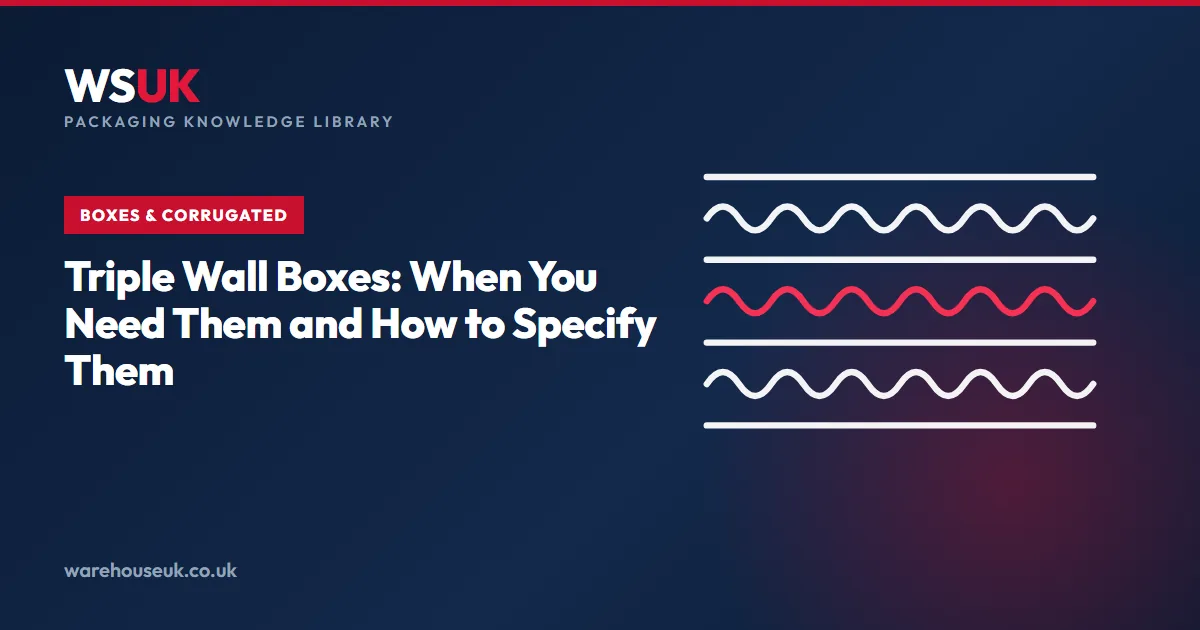
Triple wall corrugated board has three fluted layers bonded between four liners. The third layer adds thickness and, more importantly, the column strength that lets a case carry weight above it without folding. AAA is three A flutes; BAA combines a B flute with two A flutes. Both come out at around 14 mm or more, against roughly 6 to 7 mm for BC, the usual heavy-duty double wall grade.
The flute letters only describe the shape. The papers in the liners and fluting decide how strong that shape is, so two triple wall boxes that look identical can perform very differently. "Triple wall" on its own is a description, not a specification.
When double wall stops being enough
Most heavy goods do not need triple wall. Double wall handles a great deal of palletised despatch well, and the step up should be made because something specific has outgrown it:
- The weight is concentrated. A single heavy item on a small footprint loads the base and lower walls hard every time the case is lifted.
- Weight sits on it for weeks. Corrugated board loses strength under sustained load in a way a quick test does not show.
- The journey is long and humid. Board absorbs moisture and weakens as it does; a sea container through warm climates is far harder than a dry UK trailer.
- It is handled by forklift. Tines, clamps and pallet-truck knocks are point loads that puncture lighter board.
- It currently goes in a timber case mainly for strength.
If moderate-weight cartons arrive crushed on an ordinary UK pallet route, the answer is more often a better double wall grade, a tighter pallet pattern or edge protection. Our guide to choosing between single and double wall board covers that end of the range.
Replacing a timber case with triple wall
Timber cases are specified out of habit more often than out of need: the work went into wood when nothing else was strong enough, and nobody revisited it. For goods that need weight-bearing structure rather than impact armour, a triple wall case on a suitable base is often lighter and cheaper than timber, both to buy and to ship. It also arrives flat, is assembled on the bench rather than built, and at the destination goes out with the cardboard waste instead of being broken up.
Export adds one consideration. Solid timber packaging, including a timber pallet base, falls under the international ISPM 15 standard and must be treated and marked for many destinations. Corrugated board is outside that standard, although any timber base or blocking that remains still needs to comply.
Timber still wins for very heavy or awkward machinery that needs bolting down, loads that need lifting points, goods left on an open deck or in a yard, and anything likely to be dropped or struck hard. Triple wall is a structural material, not a crash barrier. Where building the crate is the job itself, that labour sits with our export packing service.
| Consideration | Double wall (BC) | Triple wall (AAA / BAA) | Timber case |
|---|---|---|---|
| Wall thickness | Around 6 - 7 mm | Around 14 mm and up | Specified to the load |
| Typical use | Heavier cartons, palletised despatch | Engineering parts, machinery, export | Very heavy, irregular or weather-exposed goods |
| Strength under a long stack | Moderate | High | High |
| Case weight | Light | Light to moderate | Heavy |
| Storage before use | Flat | Flat | Built or as a kit |
| ISPM 15 for export | Board not covered | Board not covered; a timber base is | Applies |
| Open storage and weather | Poor | Poor without protection | Good |
| Disposal at destination | Cardboard waste | Cardboard waste | Has to be dismantled |
How to specify a triple wall box
Triple wall cases are often made to size, produced to your specification and sampled before the run, so the detail below decides whether the sample is right first time.
Internal dimensions, and how the product sits
Specify internal dimensions, length by width by depth, taken from the product plus any restraint. On 14 mm board, confusing internal and external size loses close to 30 mm in each axis. Note where the centre of gravity sits and whether the product must be held off the base or walls. A heavy item that can move will work its way through the board, so restraint should come from fitted foam inserts or internal blocking, not loose fill.
Weight and stack load
Give the gross packed weight and, separately, what will be stacked on it, for how long and in what conditions. A 200 kg case travelling alone and a 60 kg case under three others in a container for six weeks need different boards.
Flute, burst and edge crush
AAA gives the most thickness and column strength; BAA brings a finer B flute into the build, usually on the outer face, for a firmer surface against knocks. Then specify performance, not just construction. Burst strength is the pressure the board resists before it ruptures, which relates to puncture and rough handling. Edge crush is the load a strip of board carries on its edge before buckling, the better guide to stacking. Ask for both, and for the load the finished case has been calculated or tested to carry. Our corrugated board grades are set out on the corrugated packaging page.
The base, the lid and how it is secured
Heavy cases rarely travel on their own. The usual options are an integral timber pallet base, corrugated runners or skids that take forklift tines without introducing timber, a base tray with sleeve and lid so the product is lowered in from above, or a case strapped to a standard pallet. Strapping should be specified by breaking strain against the load, with edge protection where it crosses the board.
Moisture, corrosion and the route
State the route, mode and time in transit and storage; a long sea journey changes the margin the board needs and whether barrier film or desiccant goes inside. Metal components held for weeks need corrosion protection specified with the case, which is why board, base, strapping and VCI are handled together under industrial packaging.
If a specification says "triple wall" and nothing about weight, stack load and journey, it has not been specified yet.
When triple wall is over-specification
Triple wall is over-used as often as it is under-used. It costs more per box than double wall, takes more storage room and is stiffer to fold and close on the bench. It is probably more than you need when:
- the goods are of moderate weight, travel on UK pallet networks and are not stacked for long;
- the damage comes from movement or impact, which restraint fixes and thicker walls do not;
- cartons crush because the pallet overhangs or the columns are misaligned;
- a better double wall grade would carry the stack at lower cost.
We will say so when double wall will do, and a trial on a handful of cases is worth running before a range is switched. For the wider picture, see our guide to packaging for engineering and manufacturing businesses.
Get triple wall specified against the real load
Send us the product, the packed weight, how it is stacked and where it is going. We will specify the board, the base and the restraint, and tell you plainly if double wall will do.
Frequently asked questions
What is the difference between double wall and triple wall boxes?
Double wall has two fluted layers, usually BC flute at around 6 to 7 mm thick. Triple wall has three, usually AAA or BAA at around 14 mm or more. The third layer adds the weight-bearing and stacking strength needed for heavy, long-stacked or export loads.
Can a triple wall box replace a wooden crate?
Often, where the goods need structural strength rather than impact armour or lifting points. Very heavy machinery, loads that must be bolted down or lifted by crane, and goods stored outdoors are still better served by timber.
Do triple wall boxes need ISPM 15 treatment for export?
The corrugated board itself is not covered by ISPM 15, which applies to solid wood packaging. A timber pallet base or timber blocking used with the case is covered, so that part needs checking against the destination country's requirements.
How much weight can a triple wall box hold?
There is no single figure. It depends on the board grade, the box dimensions, how the load sits inside, what is stacked above it, for how long, and the humidity of the journey. The case should be specified against your actual weight and stack load.
What do you need to quote for triple wall boxes?
Internal dimensions, packed weight, what will be stacked above and for how long, how the case travels and where to, and how it will be handled at each end. Photographs of the product and the current packaging help.