
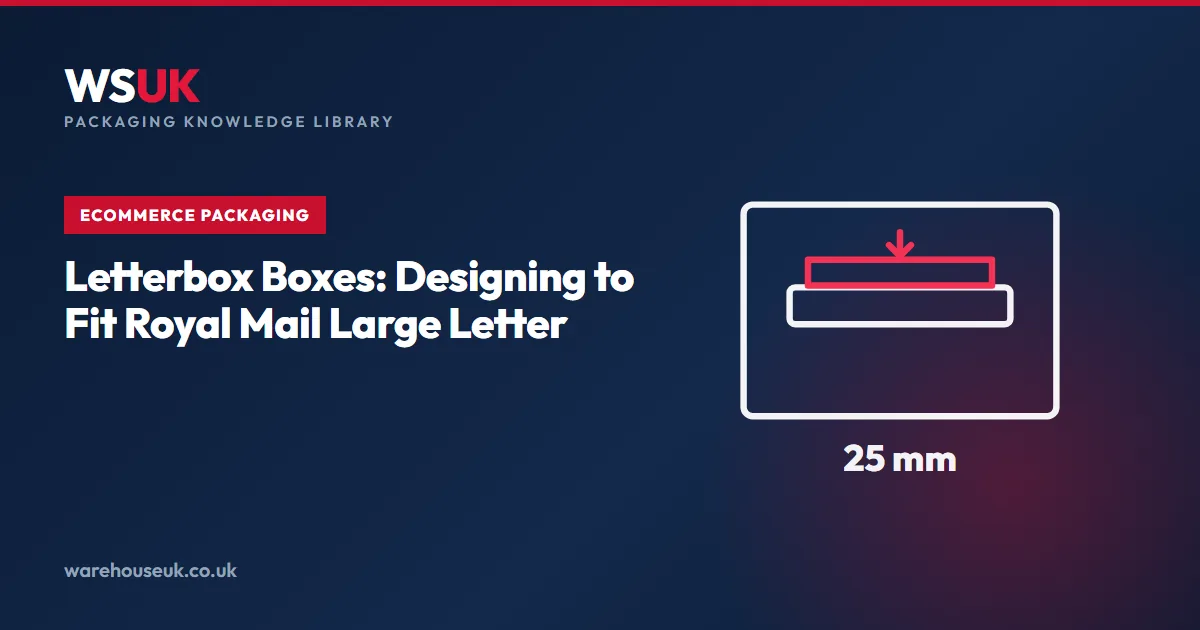
A letterbox box must stay within Royal Mail's Large Letter limits, at the time of writing (November 2026) 353 mm x 250 mm x 25 mm and 750 g, measured packed. Depth is the limit that fails: measure external depth at the thickest point, closures included, leave a margin, and check Royal Mail's current size guide.
The limits, and why depth is the one that bites
Royal Mail prices post by format as well as by weight, and has done since 2006, when it introduced Pricing in Proportion. That is why letterbox boxes are still often sold as PIP boxes. Large Letter is the format they are designed for: at the time of writing (November 2026), up to 353 mm long, 250 mm wide and 25 mm deep, and up to 750 g. Limits can change, so check Royal Mail's current size guide before committing to artwork or a production run.
Length and width rarely cause trouble: 353 x 250 mm is a little larger than A4, so a box for an A4 or A5 product sits comfortably inside it. Depth is different. Twenty-five millimetres has to hold the product, any insert, and every layer of board, and it is measured on the closed, packed item, not the flat blank or the empty box. A box that measures 24 mm empty can measure more once a product presses the lid up or one flap sits on another.
Because the format sets the postage on every despatch, a couple of millimetres here decide the cost of the whole order book.
Building a depth budget
Start from 25 mm and subtract everything that is not product.
Board caliper
Letterbox boxes are normally made from thin flutes. Our packaging materials reference gives E flute at roughly 1.1 to 1.6 mm and F flute at 0.6 to 0.9 mm; B flute, the usual general despatch profile, is 2.5 to 3.0 mm. Actual caliper varies with liners and converter, so measure the board you are offered rather than relying on the nominal figure.
Count the layers at the thickest point
At its simplest a closed box has two thicknesses of board in its depth, base and lid. Most die-cut mailers have more somewhere: a tuck flap under the lid, overlapping base panels, or a wall folded back on itself. Budget for the point where the most layers stack up, because that is where the gauge will catch.
Leave a tolerance
Board varies between batches, boxes bow slightly when filled, and not every flap gets folded perfectly flat. Keep a margin below 25 mm so the packed item passes the size gauge without forcing, and so it does not stick in a stiff letterbox at the door. The worked example uses a 2 mm margin.
| Board | Approx. caliper | Board in depth, 2 layers | Board in depth, 4 layers | Left for product at 4 layers, after a 2 mm margin |
|---|---|---|---|---|
| F flute | 0.6-0.9 mm | 1.2-1.8 mm | 2.4-3.6 mm | About 19.4-20.6 mm |
| E flute | 1.1-1.6 mm | 2.2-3.2 mm | 4.4-6.4 mm | About 16.6-18.6 mm |
| B flute | 2.5-3.0 mm | 5.0-6.0 mm | 10.0-12.0 mm | About 11-13 mm |
Four layers of B flute can take nearly half the budget, which is why it is rarely used at letterbox depth. F flute leaves the most room and suits fine print, but both E and F are low-strength profiles, so a letterbox box protects mainly by fit rather than board strength. E flute is the usual compromise. If the product is already close to 20 mm thick, the board choice decides whether the format is achievable at all.
Closures: tuck-in, crash-lock and peel-and-seal
The closure decides how many layers stack up and how quickly the bench can pack.
Tuck-in mailers. The familiar die-cut mailer with a tuck-in front and dust flaps closes without tape and presents well. Measure where the tuck flap sits under the lid and the dust flaps fold in, usually the thickest point.
Crash-lock bases. A crash-lock base locks into shape as the box is opened out, which takes seconds out of every order at the bench. The base panels overlap to do it, so count the layers there: on a deep box it hardly matters, at 25 mm it can cost a millimetre or two. Measure both ends of the box.
Peel-and-seal strips. A self-adhesive strip adds very little depth and, with a second strip, makes the box returns-ready. Tape across a box near the limit adds depth and can catch in the slot, so a tape-free closure is usually better.
Book wraps. For flat, rigid goods, a fold-around wrap fixed to the contents removes the void entirely and is usually the cheapest delivered option for that shape. The formats are compared in our guide to postal boxes and mailers.
Product fit, inserts and the weight limit
Design around the product's thickest point in its packed orientation: an item lying flat may fit at 18 mm where the same item on its edge never will. Measure several units, because moulded or soft products vary and the thickest unit in a batch is the one that fails.
Restraint matters more than cushioning at this depth. There is no room for bubble round the product, and loose fill adds depth without stopping movement. A snug fit with a die-cut card insert or a locating tab holds the item still. If the product needs real cushioning depth, it is probably a small parcel rather than a large letter, and accepting that is cheaper than paying for breakages. Where stock sizes leave the product loose, a bespoke carton made to size can be produced to your specification so the board does the restraining.
Weigh the finished pack. The 750 g covers product, box, insert, any leaflet and the label, and a heavier board chosen for strength can tip a near-limit pack over. Weigh packed samples on the bench scale and allow for variation between units.
Printed boxes face the same checks. Print adds nothing measurable, but a heavier or laminated liner chosen for finish changes the caliper, so decide print and board together and approve a sample before the run, as with any custom printed packaging.
When a pack misses, and other carriers
An item that exceeds any one Large Letter limit is no longer a large letter. Royal Mail charges by format, so it is priced as the next format up, a parcel, at a higher price on every order of that size. If it was posted at the large letter rate it is underpaid, and underpaid post can be held or the recipient asked to pay, a poor start with a new customer.
Other carriers run letterbox-sized services with their own size and weight limits, which are not the same as Royal Mail's. If you use more than one carrier, design to the tightest limit you rely on, check each carrier's current specification, and record which format each box size is built for. Our postal and parcel packaging is sized to carrier bands on exactly that basis, because a few millimetres moves a parcel into the next band on every order.
Sampling and signing off the design
Sign a letterbox box off on physical samples packed with real product, not on a drawing. Use the thickest and heaviest units you sell, close them as the bench will, and check them against a rigid slot set to the limit rather than a tape measure: a box that has to be pushed through is too deep. Weigh them packed, post a handful to real addresses, and have the packers build a few dozen to see whether the closure is quick and consistent at bench speed. Our guide to running a packaging trial covers the wider method.
Then write the specification down: board and flute, internal dimensions, closure, insert, maximum packed depth and weight, and the carrier format it is built for. That record lets a reorder or a new supplier produce the same box. Letterbox fit sits alongside carrier bands, unboxing and returns in our ecommerce packaging work.
Design a letterbox box from 25 mm downwards: board layers at the thickest point first, then a margin, and only then the product.
Get a letterbox box specified to the format
Send us the product, its thickest and heaviest units and the carriers you use. We will specify the board, closure and insert to fit the format with a margin, sample before the run, and quote the delivered cost.
Frequently asked questions
What size is a Royal Mail Large Letter?
At the time of writing (November 2026), up to 353 mm long, 250 mm wide and 25 mm deep, and up to 750 g, measured on the packed item. Check Royal Mail's current size guide before you design or reorder.
What are PIP boxes?
A trade name for letterbox boxes. It comes from Pricing in Proportion, the size-based pricing Royal Mail introduced in 2006, under which a pack's format as well as its weight sets the postage.
What board is best for letterbox boxes?
Usually E flute, at roughly 1.1 to 1.6 mm, or F flute, at 0.6 to 0.9 mm, where the product is close to the depth limit. Thicker profiles such as B flute take too much of the 25 mm once every layer is counted.
Does the 25 mm depth include the box itself?
Yes. The limit applies to the packed, closed item, so board, closures, inserts and label all count. Measure the external depth at the thickest point, usually where flaps overlap.
What happens if a letterbox box is slightly over 25 mm?
It is no longer a large letter and is priced as the next format up, a parcel. Posted at the large letter rate it is underpaid, and the item can be held or the recipient asked to pay. Keep a margin below the limit.